

In chemical and water treatment systems, pumps are required to operate continuously under high temperatures, corrosive media, and demanding working conditions. Compared with horizontal pumps, vertical pumps take up less space, offer more flexible installation, and are well suited for deep pits or tank applications. As a result, they are widely used for corrosive fluid transfer and large-scale water treatment projects.
Within a vertical pump structure, the pump casing is responsible for pressure containment and sealing, and its quality directly affects operational stability and service life.
Special Strength and Stability Requirements of Vertical Pump Casings.
The structural characteristics of vertical pumps mean that the casing must withstand axial loads, internal pressure, and long-term stress concentration during operation. In high-temperature or corrosive environments, insufficient rigidity or improper wall thickness distribution can easily lead to deformation, fatigue, or sealing failure.
A vertically cast pump casing benefits from integral forming, allowing critical stress-bearing areas to be reinforced at the design stage. This helps the casing maintain structural stability over long operating periods. In chemical and water treatment systems, this stability is essential, because even minor structural changes can be amplified under continuous operation and ultimately compromise system safety.
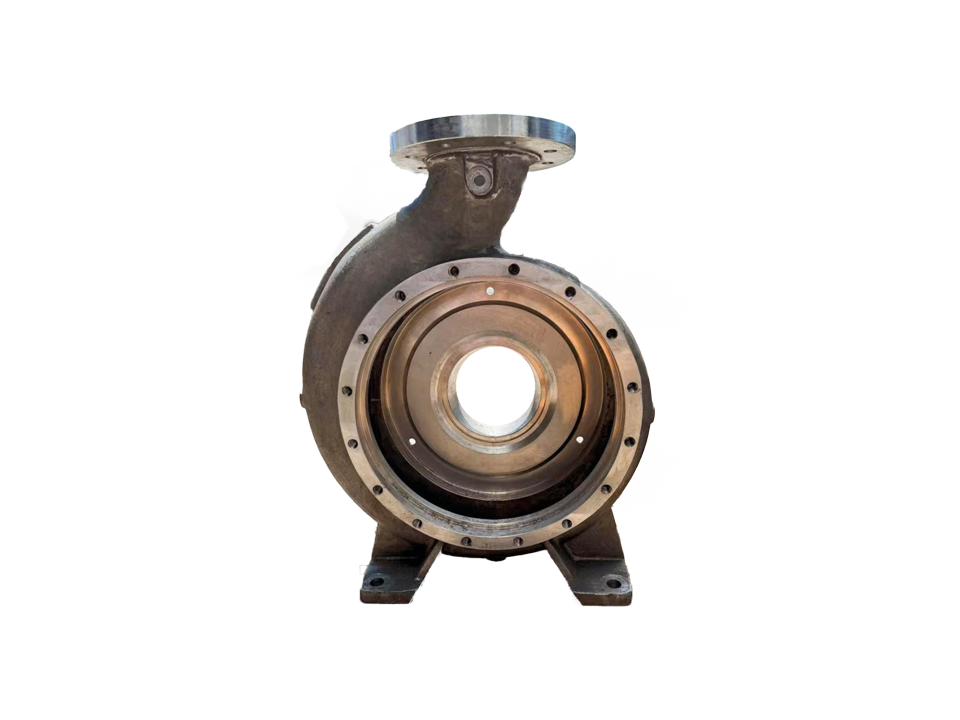
Application Value of Stainless Steel in High-Temperature and Corrosive Conditions.
Chemical and water treatment media are typically corrosive, high-temperature, and compositionally complex, placing clear demands on casing materials. Stainless steel pump casings offer strong corrosion resistance, thermal stability, and mechanical strength, enabling reliable performance under harsh operating conditions.
We use stainless steel as the primary material for our vertical pump casings to meet the long-term safety and reliability requirements of chemical and water treatment systems, rather than focusing only on short-term cost considerations.
High-Standard Casting Is the Foundation of Long-Term Performance.
In real-world applications, many pump casing issues do not appear during initial operation. Instead, they develop gradually due to temperature fluctuations, pressure variations, and ongoing media corrosion. Casting defects such as porosity, shrinkage, and inclusions often become the root cause of leakage or structural failure later on.
During the production of vertical pump casings, we strictly follow GB, ASME / ASTM, EN, ISO, and JIS standards for both casting processes and quality control. Through stable casting methods and consistent process management, we ensure that each single-piece Cast steel pump casing delivers predictable structural performance throughout its service life.
Long-Term System Value from a Lifecycle Perspective.
In chemical and water treatment projects, the pump casing is not a component that only matters when problems occur. It defines the safety boundary of the entire system. The quality and suitability of a Cast steel pump casing directly influence maintenance cycles, operational risks, and overall system reliability.
From a long-term operating perspective, selecting a vertical pump casing with a well-designed structure, reliable material selection, and controlled manufacturing processes is a practical way to reduce uncertainty and support continuous operation.
We support customized production of vertical pump casings based on customer drawings or specific operating conditions. By optimizing structure, wall thickness, and critical areas, we ensure that each Cast steel pump casing is well matched to real application scenarios and capable of stable, long-term performance.