

Sand casting is the most widely used and cost-effective casting process in the pump manufacturing industry, primarily employed for producing medium to large-sized pump bodies, pump covers, bearing housings, and other relatively robust or large-scale cast iron or steel components.
For the characteristics of pump components, the specific applications of sand casting are as follows:
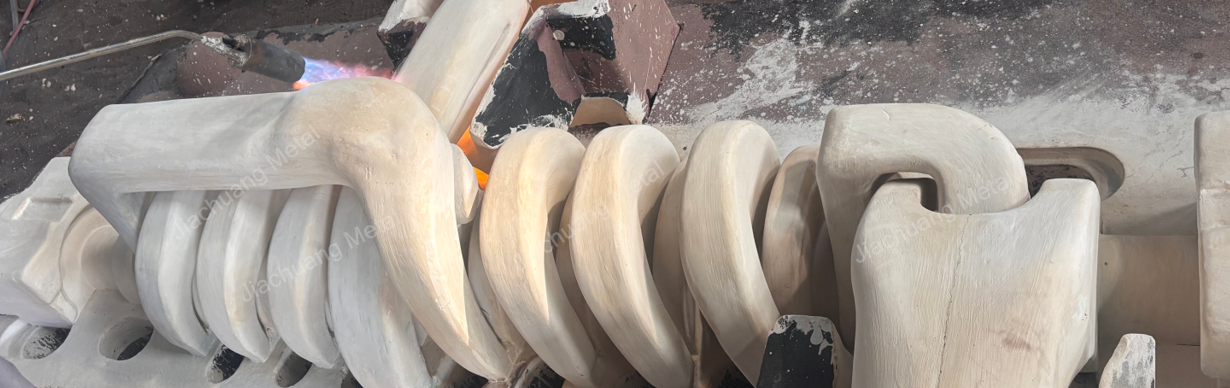
1. Applicable Scenarios and Components
Main components: pump casing (volute), pump cover, support (bearing housing), large impeller (typically diameter >500mm).
Applicable Materials: Gray cast iron (HT200/250), ductile iron (QT400/500), carbon steel, and low-alloy steel. For stainless steel pump components, sand casting is also commonly used, but higher requirements are placed on the refractoriness of the molding sand.
Batch and Size: Suitable for single pieces, small to large batches, especially ideal for heavy-duty or oversized pump housings (DN500 and above).
2. Common Sand Casting Process Types
Clay wet sand casting:
The most traditional method, automated molding machines (such as green sand molding lines), is highly efficient.
Suitable for mass production of small and medium-sized clear water pump bodies, with low cost but average casting precision (CT10-12) and relatively rough surface.
Resin self-hardening sand casting (phenolic/furan resin):
The most mainstream sand casting method in the pump industry, particularly pit molding or manual molding.
Advantages: High strength, good dimensional accuracy (CT9-11), excellent collapsibility, capable of creating complex runner systems or spiral flow channels, and easy to modify.
Commonly used for the production of single pieces, small batches, or large pump bodies.
3. Technical Key Points of Sand Casting for Pump Components
Parting line selection: The pump body is typically parted along the axis or flange surface. For complex volute pump bodies, multi-cavity molding (three or more) or the use of numerous cores (sand cores) may be required to form internal flow channels.
Sand Core Manufacturing:
Internal flow channels, inlet/outlet flange holes, and sealing ring seats are typically formed using sand cores.
Sand casting of impellers typically requires a highly precise sand core to form the passages between the blades (commonly seen in large cast steel impellers).
Gating system: The pump body is mostly a pressure-bearing component, and the gating system must be designed rationally (e.g., bottom gating or stepped gating) to prevent sand washout and slag inclusion, ensuring smooth filling of the mold cavity with molten metal and minimizing the risk of leakage during hydrostatic testing.
4. Analysis of Advantages and Disadvantages
Advantages:
Extremely high flexibility: Almost unrestricted by part shape, size, and weight.
Low cost: The molds (wood or aluminum) are inexpensive, and the shaping materials (sand) are affordable and recyclable.
Material adaptability is wide-ranging: it can be applied from cast iron to cast steel.
Disadvantages:
Lower precision: Larger dimensional tolerances, with machining allowances typically requiring 3~8mm, resulting in lower material utilization compared to precision casting.
Surface quality is average: requires subsequent shot peening for cleaning, as the roughness does not meet the requirements for direct flow passage.
Labor intensity: Manual molding still accounts for a significant proportion and is significantly influenced by workers' technical proficiency.
Summary: If your pump components are large-sized cast iron/cast steel structural parts, or involve small batches with extremely low mold costs, resin sand casting is the most common choice. For small cast iron parts in large-scale production, an automatic wet sand molding line would be selected.