

Casting pump casings are the core pressure-bearing components of a water pump, and they typically contain complex internal flow channels (such as volute structures). Therefore, casting is the most important and mature process for producing casting pump casing.
The casting process of a casting pump casing is a complex process that integrates materials science, thermodynamics, and machining. The following is a detailed process flow based on the most commonly used sand casting method, also covering other methods such as precision casting.
After our company receives an order, we will contact the factory department to carry out the following steps:
1. Process design and mold making.
This is the foundation that determines the final casting pump casing quality, accuracy, and durability.
• Process analysis: Our engineers will analyze the structure of the pump casing based on the drawings to determine the parting surface (the location where the mold opens), the gating system (the channel through which the molten metal flows), and the risers (used for feeding and preventing shrinkage cavities).
• Pattern making: A "pattern" of the casting pump casing is made according to the design. The material is usually wood (for single pieces or small batches), resin, or metal (aluminum/steel, for large batches).
• Core box making: The inside of the casting pump casing is hollow and has a complex shape (such as the impeller chamber and inlet/outlet flow channels), making direct demolding impossible. Therefore, sand cores must be made. The core box is the mold used to make these sand cores.
2. Molding and core making.
• Core making: The core sand mixed with binder is injected into the core box, cured, and then removed to form the internal flow channel shape of the pump casing. To ensure venting and strength, the sand core is usually coated with a refractory coating.
• Molding:
The pattern is placed in a sand mold, and molding sand (commonly resin sand or water glass sand) is filled in and compacted. The pattern is then removed, leaving a cavity consistent with the outer shape of the pump casing.
Core setting and mold closing: This is the most technically demanding step. The prepared sand core is placed in the lower mold cavity, and must be positioned precisely to ensure uniform wall thickness. Then the upper mold is covered and the sand mold is locked.
3. Melting and pouring.
• Melting: According to the material requirements (such as gray cast iron, ductile iron, stainless steel, bronze, etc.), the metal is melted in an electric furnace or cupola furnace. • Composition Adjustment and Inspection: Before pouring, the molten iron/steel must undergo spectral analysis to adjust the content of elements such as carbon, silicon, manganese, and chromium, and undergo inoculation or spheroidizing treatment (for ductile iron).
• Pouring: The qualified high-temperature molten metal is poured into the pouring cup of the mold. The pouring speed and temperature need to be strictly controlled; too fast can cause gas entrapment, and too slow can lead to cold shuts.
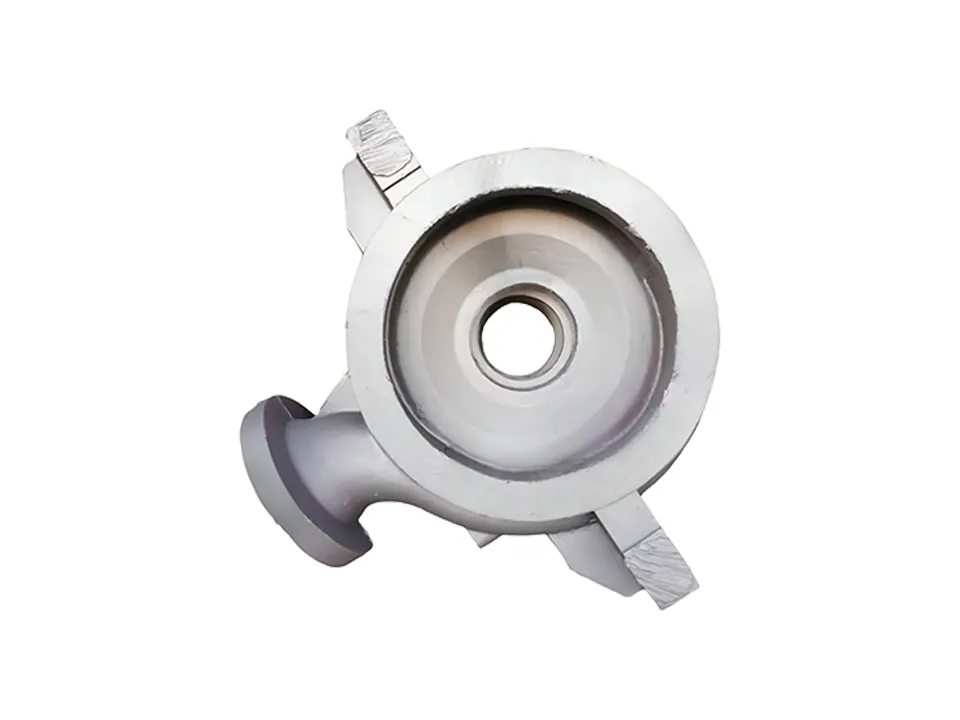
4. Cooling and Sand Removal.
Solidification and Cooling: The molten metal cools and solidifies in the mold. For thick-walled pump casings, the cooling time may be several hours or even days to prevent thermal cracking.
Sand Removal: After the casting is completely solidified, the sand mold is broken using vibrating equipment, and the casting is removed. At this point, the casting surface still has a large amount of sand adhering to it and is attached to the gating system.
5. Cleaning and Post-processing.
Gating System Removal: The excess metal runners and risers are removed using a cutting machine or gas cutting.
Surface Cleaning: The casting surface is polished using a shot blasting machine to remove scale and adhering sand, exposing the metallic luster of the pump casing.
Grinding: Manual grinding is used to remove parting line flash and burrs.
6. Heat Treatment.
To eliminate casting stress and prevent deformation or cracking during subsequent processing, most pump casings require heat treatment:
Annealing/Aging Treatment: Used for gray cast iron to eliminate internal stress.
Solution Treatment: Mainly used for stainless steel pump casings to obtain better corrosion resistance.
Quenching + Tempering: Used for alloy steel pump casings requiring high strength.
7. Machining and Testing.
This is the final stage before the delivery of the casting pump casing, and it is an extremely important step.
Rough Machining and Finish Machining: Key parts such as flange surfaces, bases, and bearing holes are machined to ensure fitting accuracy.
Hydrostatic Testing: This is the most critical acceptance step for the casting pump casing. After the pump casing is sealed, high-pressure water (usually 1.5 times the working pressure) is introduced and maintained for a certain period to check for leaks (porosity and shrinkage cavities can cause leaks). Other tests include dimensional inspection, re-testing of material chemical composition, and non-destructive testing (such as ultrasonic testing (UT) and magnetic particle testing (MT)) for critical pump casings.
Common Casting Methods for casting pump casing:
| Casting Method | Applicable Scenarios | Characteristics |
| Sand Casting | Most commonly used. Suitable for various sizes of industrial pumps (such ascentrifugal pumps, multi-stage pumps). | Low cost, mature technology, strong adaptability, but generally rough surface finish. |
| Precision Casting | Used for stainless steel pumps, chemical pumps, or applications requiring extremely high flow channel surface finish. | Extremely high dimensional accuracy, smooth surface, almost no machining required, but high cost and limited by size. |
| Lost Foam Casting | For double-suction pumps or slurry pumps with extremely complex structures. | No parting line, no flash, good dimensional accuracy. |